The captain's nine
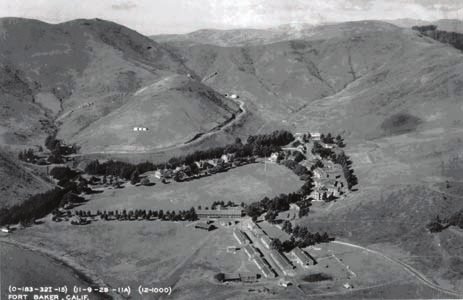
By December 1923 Capt. Manly B. Gibson of the Coast Artillery was at Fort Baker, already lending the post's basketball court to Sausalito's young men,1 and by the spring of 1924 he was its commanding officer.2 The Sausalito News later said the idea of a golf course came to him soon after he took command. Being "a confirmed addict of the royal and ancient pastime," he set out to build the sort of course he had always hoped to find.3 The nine holes opened in late March 1924, laid out under his supervision, with Gibson as president of the new Fort Baker Golf Club.2
Army rules let civilians play only on invitations good for a month, with no charge but green fees. Gibson met them by issuing invitation cards at $3 a month, and by the autumn of 1924 there were 150 of them out.4 Sausalito's Chamber of Commerce made him an honorary member.5 In January 1926 the San Francisco Examiner's motoring section called him the exception among Army officers, one who believed his reservation should "serve the largest possible peace-time utility."6 The club notes called him one of its most enthusiastic golfers, a man who tried to go round the course at least once a day.7 In February 1925 he opened the course free to junior foursomes from Marin churches, schools and lodges.8 That April the Ninth Corps Area asked for the club's by-laws and plans as a model for golf at other Pacific Coast posts.9
He named his nine holes after the A.E.F.'s battles in France, from the Marne to the Meuse-Argonne, and he dreamed of a second nine of "ocean" holes, with a salvaged $30,000 barge in Horseshoe Bay as the 18th tee.3 In September 1925 he told the Chamber that workmen were starting on nine more holes.10 N. L. Fitzhenry of the Dipsea Highway Association said Gibson "deserves great credit for producing in Marin county this unique feature."11
The commander
The Sausalito News later said his interest in the town built "a strong bond between civil life and the activities of Fort Baker."12 He helped found the Sausalito Rifle Club in 1924,13 and in 1926 he arranged a trial boat service from San Francisco on which the golf club's civilian members rode free.14 When Sierra Club hikers "attacked" Battery Kirby that autumn, he ran up the white flag and then showed them the guns.15 In January 1927 the United Press reported his tests of the "Gibson code," a system of numbered words meant to let people write to one another across languages. Nine soldiers, each speaking a different tongue, were writing sentences in it within half an hour.16 His brother W. Gordon Gibson was secretary of the Sausalito Chamber of Commerce,17 and their father was the Rev. W. H. Gibson, a Salinas minister.18 A daughter was born to Captain and Mrs. Gibson at Fort Baker in January 1927.19 In June 1927 the Army ordered him from Fort Baker to the Coast Artillery School at Fort Monroe, Virginia,20 though the Sausalito News still mentioned him at the post that November.21
The WPA course
By October 1937 Gibson was back as a major in the 6th Coast Artillery, commanding Forts Baker and Barry. He announced that the golf club would be reorganized.22 In 1938 he announced an $856,598 WPA project to rehabilitate the two posts,23 and he set the guest card at $2 a month, with a limit of 100 players.24 He commanded the Coast Artillery troops paraded for President Roosevelt at the north end of the Golden Gate Bridge,25 and he tried to buy back for the post a silver service that had been presented in 1860 to Col. Edward D. Baker, the fort's namesake.26 He gave the Tamalpais High golf team free use of the new course: "We are glad of the opportunity of being able to assist."27
The course, nine holes with 18 tees, 6,137 yards long and par 71, was credited largely to his two years of effort.28 It was dedicated on 9 July 1939 at an open house the Sausalito News called the culmination of his work.29,12 A few days later he and Mrs. Gibson sailed on the Army transport Republic for Independence, Missouri, where he was to head the department of military science and tactics at the high school.30 Maj. Evans R. Crowell succeeded him at Fort Baker.31 The Army and Navy Journal listed the same move as an order to the Seventh Corps Area at St. Louis, probably the headquarters he served under at Independence.32
The rest of a long career
Gibson had entered the Coast Artillery as a second lieutenant in 1917.33 His numbered-word language drew national notice in 1927 as the "World Figure Code," in which some 10,000 words were written with the digits 0 to 9.34 Between his two Fort Baker tours he served in Hawaii and at Fort Banks, Massachusetts, twice commanding the harbor defenses of Boston for short spells,35 and in 1936, as a major on Corregidor, he was the post's arboricultural officer.36 In 1941, as a lieutenant colonel commanding the 56th Training Battalion at Camp Callan, he made news again with a device for teaching recruits to aim using BB guns.37 He retired as a colonel on 31 August 1947.38